Our first visit to the Norton Simon Museum was too short. We returned to wander the garden and see the collection on the lower level.
The lily filled pond is surrounded by bronze sculpture, mainly by Henry Moore. This one is titled "King and Queen".
The lower floor has temporary exhibits. There we learned about Hinduism, Buddhism, and Jainism through examples of sculptures in bronze and stone.
There were several Shiva
and Vishnu.
We labeled this Temple Wall with scenes of Krishna’s life incorrectly in a previous blog.
The second exhibit we saw was a lesson in the history of the color Blue. Not being artistic, we did not know that blue is the hardest color to create. Prior to 1706, the only blue painters used was ultramarine, aka true blue. Then a painter made a mistake mixing his colors and created Prussian blue. Seeking to develop an animal oil to cure sickness, he combined blood with potash. He anticipated red but found a deep blue. Working with a chemist, the two were able to market the color, providing a new color for painting. With each iteration, more shades were added, next cobalt, then French ultramarine. These colors increased the richness and texture of the paintings. Along the way, the development of squeezable paint tubes made it possible for artists to carry their materials to their subject. Here are a couple of examples of how the different blues were used.
Now, on our visits to museums, we will have a greater appreciation for the many shades of color used to create paintings.
Before we left, we returned to a few of the paintings that most intrigued us, primarily The Ragpicker by Edouard Manet. This man selling rags to buy food looks like he could step off the wall and shuffle through the gallery.
The Flower Girl with Lilies by Diego Rivera
and Tulips in a Vase by Paul Cezanne.
We spent today (yesterday for you) doing errands in preparation for Cheryl, Dave and Bennett. Our reward in the evening was a good dinner at Panda Inn followed by the excellent movie, Grandma.
If you remember that line, you lived in San Francisco in the 60s. It was a slogan for Pan Am telling you about Flight 1 originating in San Francisco and going around the world. Pan Am is gone but the slogan put the travel bug in us and we have been working on doing it ever since.
Tuesday, 29 September 2015
Monday, 28 September 2015
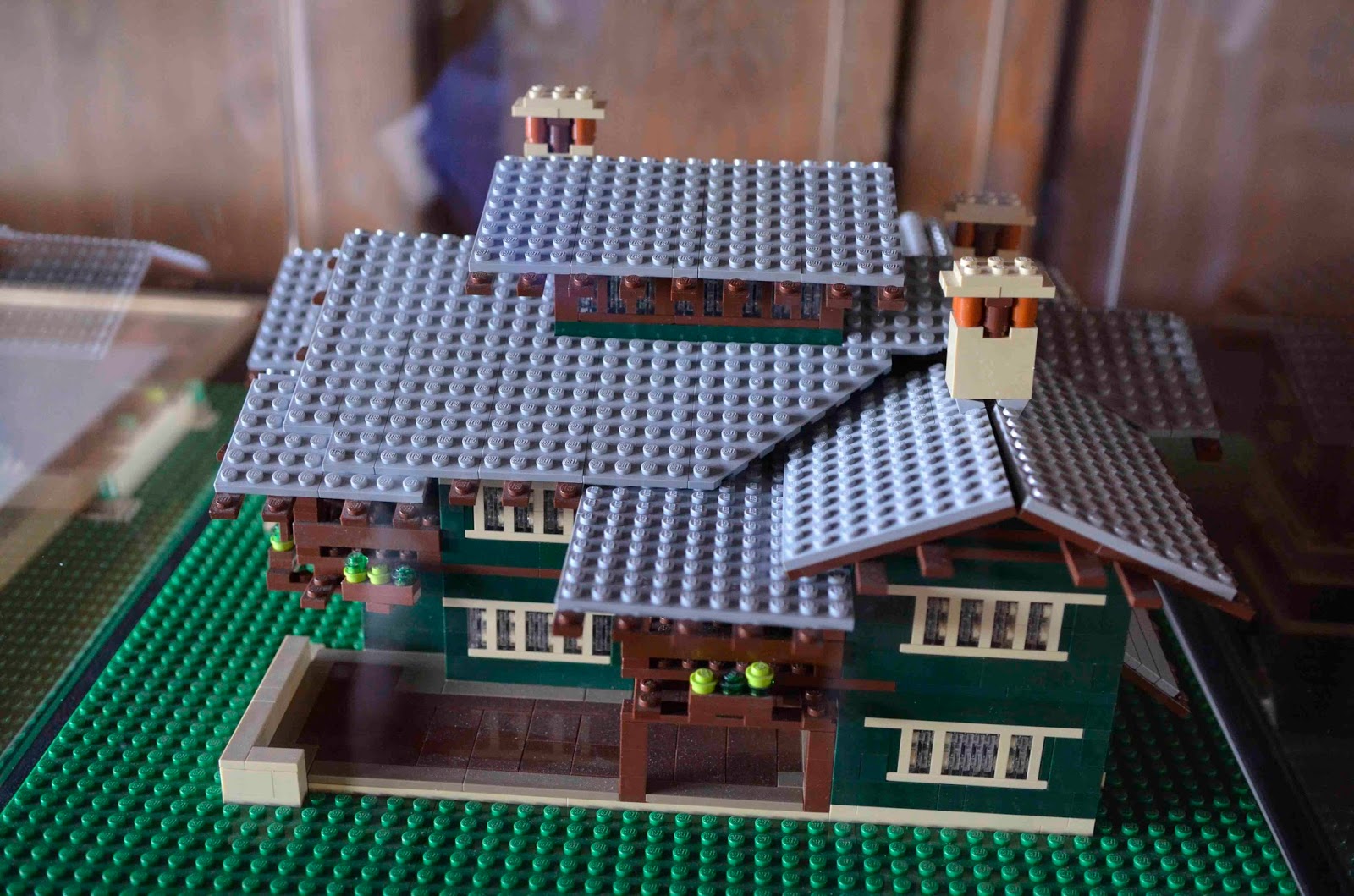
The Gamble House
David and Mary Gamble of Proctor and Gamble annually left Cincinnati to spend their winters in mild Southern California. When they retired, they decided to make their permanent home in Pasadena and chose Charles and Henry Greene as their architects to build their new home. Known for their Craftsman design, the artists worked closely with the owners to build one of the best examples of that unique style.
We entered through a work of art, the stained glass front door.
The house and furnishing are of a variety of woods which accent the designs. The Greenes Arts and Crafts style made jointery an artistic detail rather than something to hide. Greene & Greene construction features finger joints and a lot of tongue and groove joints. This "scarf joint" is typical.
The Gambles added new features such as closets, each with its own door style and with floor-level drawers for shoes.
The Gambles traveled the world and collected both the mundane and the exotic. They spent considerable time in Asian and there is a strong Asian influence in much of the design. Mrs. Gamble was also a collector of Tiffany glass, vases and flower bowls which are on display. She was the one who decided the detailed accent colors in a room making sure they blended with the art she placed there. Their collection is displayed about the house.
Outside each bedroom is a summer porch for sleeping on mild LA nights. This pond is below the porch of Mrs. Greene’s spinster sister who lived with them and was the last surviving member of the family to live in the home.
The interior is dark because the then new electric lights were of low wattage. The only “bright” room is the attic which is now used as a meeting room. The University of Southern California and the City of Pasadena now own the house and are committed to keeping it the way the Gambles and Greenes created it.
Photography is limited to the outside but some of the wonderful details we saw were also part of the exterior.
This Lego model of the house is a recent acquisition.
After touring the house, we drove around the lovely neighborhood finding more Greene homes.
Sunday, 27 September 2015
Sam Maloof, Woodworker
One of America’s most esteemed of furniture makers was Sam Maloof. His home and shop
are a historical landmark and are available for tours. Jerry, also a woodworker, has wanted to visit his home for a long time. He took the three-hour (actually four hours) master-craftsman tour led by Larry who worked with Maloof for almost thirty years. Anna Lee took the general tour. Each tour gave insights into the creativity of this master furniture maker. He was an inveterate collector who amassed wood and metal discards by the dozens. He then used them in the home he built. His imagination extended to such ideas as having differently designed wood door handles on each side of the doors throughout his home.
When the state decided to build Interstate 210, his home was in the way. They wanted to demolish the house but, as it was listed on the National Register, the state had to move it instead. The craftsman he hired cut the house into seven sections and moved it about two miles to its present location. The location now includes his old home, a newer home he built for his second wife, his shop, five sheds for storing wood, an educational center, a gallery, and a visitors center. This is an exterior view of the home.
The newer home is still occupied and not included on tours. Photos were not permitted in the house and Jerry actually had to check his camera before entering and Anna Lee had to check her purse. We could take pictures in the shop however and here are a few. Anna Lee was quick to point out to Jerry how clean the shop was, no sawdust on the floor.
It is interesting to note that Maloof did not do shop drawings. Everything was designed in his head and he kept refining his products over the years. He was entirely self taught and never took a woodworking class. His attitude was that, if something had a slight flaw, that was fine, it showed that the piece was hand made. He did not finish the backs of his furniture because no one saw these pieces. Maloof’s famous rocking chairs sell for $25,000.00. A beautiful baby cradle sold for $50,000.00 and one unnamed buyer had twins and bought two of them. Here are a few views of the shop.
A chair being made
A seat in the raw.
Here is a rocker waiting to be finished.
Jerry was drooling when they entered the wood storage rooms. There were five of them and the tour included entry into two. One single piece of wood was four feet wide by about ten high. Jerry asked want is was worth and the response was “a lot”.
While Jerry was on the longer tour, Anna Lee wandered the garden enjoying the sculpture. It was too late for flowers but there is much to enjoy.
One example is the visual pun, Door Ajar.
This lady shared her garden.
The Totem Trees fill a garden plot with their whimsy.
Saturday, 26 September 2015
Norton Simon Museum
We start our fall trip by coming to the greater Los Angeles area which gave us an opportunity to visit sites that have been on our list for a long time. Anna Lee has wanted to go to the Norton Simon Museum for decades (really). We spent our first afternoon there.
Simon was a very wealthy industrialist who discovered art in his forties. Not a man to deny himself, he first immersed in learning about art then in acquiring whatever pieces he desired. His collection spans six centuries and includes almost all the great painters of each era. He also collected sculpture. The following are samples of our favorite pieces.
Assembly of Sea Forms by Barbara Hepworth. The back row is the sea mother and sea king, the middle row the shell, seaform and young and rolled seaform, the front row is embryo and seabird.
Edgar Degas: The Tub
Edouard Manet: The Ragpicker. As the sign explained, this life-size painting represents the 19th century equivalent of today’s homeless man.
An Indian Chess Set (chess was invented in India).
Indian Alterpiece with multiple Jinas (someone who has achieved spiritual enlightment).
We were ready for dinner and Jerry found Gyu-Kaku, a fabulous Japanese/Korean BBQ. Plates of vegetables and meats were set before us. We munched on appetizers while grilling our dinner. Just in case we were still hungry, the waitress brought us a bowl of bulgogi (Korean meat and rice) that was as good as any we had in Korea.
Continuing to use our grill, we toasted marshmallows for our s’more dessert.
Tuesday, 9 June 2015
Family
We spent our last weekend in DC enjoying family. We joined with the Levy/Steinberg family celebrating the graduation of Allan who will be at Cal in the fall. Go Bears!
Jeff arrived late that night for some game we do not understand but were happy to have him with us. Bennett enjoyed his “Uncle BangBang.”
The local farmer’s market is a short walk from the house so we went shopping. Bennett likes his transportation.
The next day we had good dim sum. Bennett really packed it away. Jeff, Jerry and Anna Lee went to the Kennedy Center for a free concert. We thought it would be all-Sousa since it was billed as The John Philip Sousa Band Festival. What we were treated to instead were four different school groups who had won their trips to DC to perform at the Kennedy. The surprise was the Chaparral Middle School Wind Ensemble from Diamond Bar, CA, not far from where we live. The students were excellent as were all the groups. It was another example of not getting what you expect and still being rewarded.
DC got hot and humid and Bennett found the perfect way to cool off.
We had our last evening of reading books to Bennett, all Penguin-themed. In the morning Bennett and Anna Lee played one-two-three, a game of swinging on the hammock on the front porch.
We look forward to being together again in the fall.
Tuesday, 2 June 2015
Wandering the District
The day after Memorial Day, we headed to the Mall to take photos. Many of the mementoes left at the Vietnam Memorial were still there reminding us of the MIAs as well as the more than 50,000 American lives lost there.
The Washington Monument, now repaired from damage inflicted in the 2011 earthquake, towers over the memorials and tributes along the Mall.
The Lincoln Memorial is always crowded with visitors.
The next day, we lunched at Old Ebbitt Grill, the oldest saloon in DC, with friends Don and Barbara. We had not been together in a couple of years so we were pleased that the restaurant let us talk for hours.
The Old Ebbitt has an interesting history. It was founded in 1856 and has been in many different locations. Such notables as Presidents Grant, A. Johnson, Cleveland, T. Roosevelt and Harding have been served there. Supposedly McKinley lived there when he was in Congress.
It now calls itself “a virtual saloon Smithsonian.” It has collections of such items as beer steins, animal skins and heads (maybe bagged by Theodore Roosevelt), and antique gas chandeliers.
On the wall is a painting by Czech impressionist Kamel Kubik celebrating V-E Day and inspired by Truman’s words, “The flags of freedom fly over Europe.”
Our last Mall stop of the day was to pick Bennett up from his preschool located in Natural History. He and his friend stopped to talk after school. The three of us hopped the Metro to go home and let Mom and Dad have a date night.
The next day we toured the Library of Congress. The Library receives two copies of every book, photo, song, fabric, etc, that require copyright. Twenty thousand new books arrive daily. During the last shutdown, semi trucks were lined up outside the building. The beauty of the building itself is worth the trip.
We especially enjoyed the reproduced Jefferson Library and looking at his own books filling the shelves. Those with white covers represent books lost due to earlier fires.
The statues lining the balconies above the reading room represent the many fields of knowledge while paintings show the changes man has gone through from primitive communication to literacy.
One of the featured exhibits was an original Guternberg Bible and a Mainz Bible, two of the greatest treasures in the Library. One is hand written and one is printed with movable type.
What hasn’t changed much is the way government continues to function. Five lunette paintings done in 1898 by Elihu Vedder show the effects of good vs bad government, ranging from Corrupt Legislation and Anarchy to Good Administration with Peace and Prosperity. The paintings show industry polluting the air and water as people suffer on one side and everyone working together and benefitting on the other. It shows that we are still fighting the same issues one hundred years later.
Needing a bit of repast we went deep under the Library of Congress to a coffee shop. This is the what the warren of tunnels looks like. Check out that rambling romex.
The Washington Monument, now repaired from damage inflicted in the 2011 earthquake, towers over the memorials and tributes along the Mall.
The Lincoln Memorial is always crowded with visitors.
The Old Ebbitt has an interesting history. It was founded in 1856 and has been in many different locations. Such notables as Presidents Grant, A. Johnson, Cleveland, T. Roosevelt and Harding have been served there. Supposedly McKinley lived there when he was in Congress.
It now calls itself “a virtual saloon Smithsonian.” It has collections of such items as beer steins, animal skins and heads (maybe bagged by Theodore Roosevelt), and antique gas chandeliers.
On the wall is a painting by Czech impressionist Kamel Kubik celebrating V-E Day and inspired by Truman’s words, “The flags of freedom fly over Europe.”
Our last Mall stop of the day was to pick Bennett up from his preschool located in Natural History. He and his friend stopped to talk after school. The three of us hopped the Metro to go home and let Mom and Dad have a date night.
The next day we toured the Library of Congress. The Library receives two copies of every book, photo, song, fabric, etc, that require copyright. Twenty thousand new books arrive daily. During the last shutdown, semi trucks were lined up outside the building. The beauty of the building itself is worth the trip.
We especially enjoyed the reproduced Jefferson Library and looking at his own books filling the shelves. Those with white covers represent books lost due to earlier fires.
The statues lining the balconies above the reading room represent the many fields of knowledge while paintings show the changes man has gone through from primitive communication to literacy.
One of the featured exhibits was an original Guternberg Bible and a Mainz Bible, two of the greatest treasures in the Library. One is hand written and one is printed with movable type.
What hasn’t changed much is the way government continues to function. Five lunette paintings done in 1898 by Elihu Vedder show the effects of good vs bad government, ranging from Corrupt Legislation and Anarchy to Good Administration with Peace and Prosperity. The paintings show industry polluting the air and water as people suffer on one side and everyone working together and benefitting on the other. It shows that we are still fighting the same issues one hundred years later.
Needing a bit of repast we went deep under the Library of Congress to a coffee shop. This is the what the warren of tunnels looks like. Check out that rambling romex.
Subscribe to:
Posts (Atom)