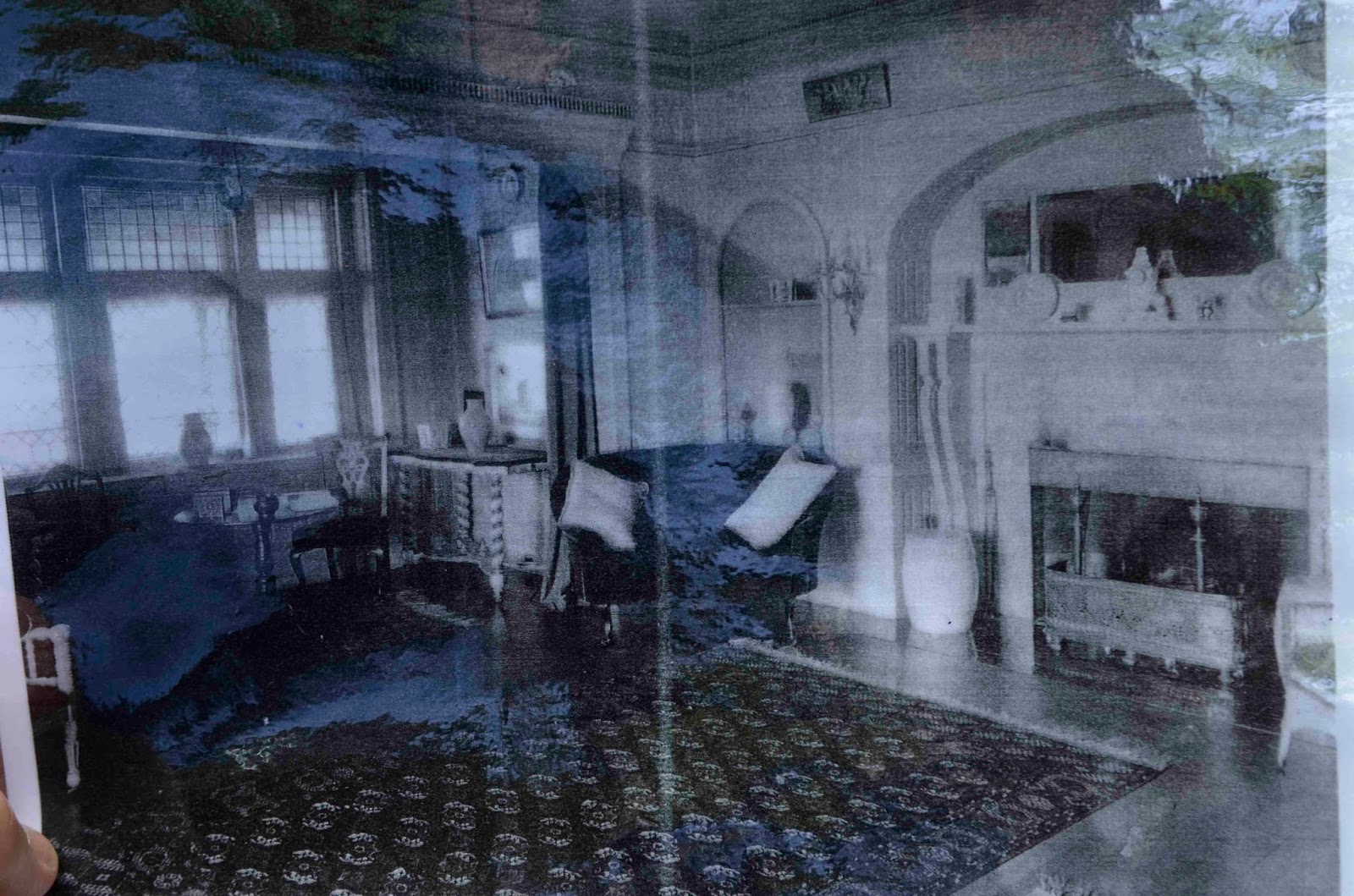
While Dave, Bennett and Cheryl hiked along the beach, Jerry and Anna Lee took the Missing Mansion Tour to learn about the history of Acadia. In 1800s this area, now lush with trees, was farmland. Then wealthy families escaping the summer heat of New York and Boston began to build summer homes. In the late 1800s the Dorr family of Boston, heirs to a textile fortune, bought one of the farms and built a 15,000 square foot mansion called Oldfarm overlooking Frenchman’s Bay.
We were shown several photographs of the exterior and interior of the mansion as well as its floor plan.
Their son, George, a Harvard graduate, loved Oldfarm on Desert Island where Acadia is located, and made preserving it his life’s work. Here is a photo of him as a young man.
He was part of a group of wealthy men who stopped further growth and committed themselves to saving the land. George lobbied the Secretary of Labor who recommended $50,000 to establish the park when what all George hoped for was $4000 ($10,000 was appropriated). The State of Maine opposed the park because of the loss of tax revenue from the high end estates.
Acadia has had two previous names, Sieur De Monts National Monument and Lafayette National Park. It was the first NP on the East Coast and the only one formed from private donations. The Moore sisters offered to donate their land if the “French” name was removed, so it became Acadia NP.
Unfortunately, the Park Service did not want George’s house as part of the natural area so it was torn down. The herringbone brick floor remains.
The granite that made up the mansions walls were buried near by. Dorr was Superintendent of Sieur Du Monts for the salary of $1 a month, a post he held until his death in 1944.
If you remember that line, you lived in San Francisco in the 60s. It was a slogan for Pan Am telling you about Flight 1 originating in San Francisco and going around the world. Pan Am is gone but the slogan put the travel bug in us and we have been working on doing it ever since.
Sunday, 12 June 2016
Saturday, 11 June 2016
Acadia National Park
While Dave took a bike ride, the rest of us drove the circle route around this gorgeous park. Not knowing where you are going can lead to lovely surprises. For us it was Asticou Azalea Garden. We arrived at a good time for most of the blossoms.
The ponds have ducks and ducklings
a Japanese rock garden,
and stepping stones
along with acres of beauty.
Back at the campground, Bennett practiced his construction skills using available materials.
The ponds have ducks and ducklings
a Japanese rock garden,
and stepping stones
along with acres of beauty.
Back at the campground, Bennett practiced his construction skills using available materials.
Friday, 10 June 2016
A gorge and a notche
waded
and crossed bridges.
Our destination was Franconia Notch, a place we had enjoyed on an earlier trip. We camped in a parking lot near Cannon Beach. Bennett checked out the water in the local lake.
Jerry and Anna Lee had hiked the Notch and remembered a steeeeep climb. The climb is still steep but the views magnificent.
The Notch was created by glacial action and erosion. This is an example of debris left by the glacier.
This bridge is for buses that go part way up the trail.
There was much to see, including mushrooms
and tree stumps.
The flume is the result of lava, ice and water eroding the granite.
We followed the path, walked the planks and climbed the stairs through the flume to its top in the woods.
While not old growth, there are Hemlock and Yellow Birch still growing in the forest.
Along the trail back down, Cheryl, Dave and Bennett crawled through Wolf’s Den and the Bear Cave.
The trees and rocks make for tempting poses.
“Monsters” line the path.
Trees grow out of rocks.
Franconia is indeed a wonderful spot.
Thursday, 9 June 2016
Montpelier
We returned to Virginia to visit James Madison's home, Montpelier (Mount Pleasant). The introductory movie gave background on the family as well as the man. Madison’s ancestor acquired the land via “patent” or what we consider homesteading. Knowing the land was rich for farming, he built a home and developed it, making it legally his own. Madison and his eleven siblings were the third generation on land. Madison was known as the Father of the Constitution and the “Sage of Montpelier.”
He said, “... a just estimate of the happiness of our country will never overlook what belongs to the fertile activity of a free people, and the benign influence of a responsible government.”
Our first tour was the Enslaved Community Tour. Our docent told us about both of the extent of slavery and personal stories of individual slaves. Eleven to twelve million people were forcibly removed from their African land, most taken to South America. One half million were taken to the new land of America, making sixty percent of the people in the South slaves. While slavery was ended in the mid-Atlantic states, it continued to thrive in the South where many of our founding father’s lived.
Our docent explained the living and work arrangements for slaves. Farm slaves built their own shelters near where they worked and worked from “can to can’t” or dawn to dusk. This was an example of such a home.
House slaves worked 24/7 but had “nicer” homes so that visitors to the main house would see the prosperity of the owners.
Slaves skilled in crafts were hired out to other plantation owners or in town.
Our guide personalized the tour by telling stories of slaves like Billy, who went to Princeton with Madison. While there, Billy observed the freedom of northern blacks and Madison thought it would be dangerous for him to return to Montpelier where he might stir up resentments in the other slaves. He was sold into indenture and later became a merchant agent.
Paul Jennings was a personal slave to Madison.
He was with him during the White House years and was promised freedom. After Madison died, Dolley needed money and, instead, Jennings was sold into indenture and resold at a loss to Senator Daniel Webster who said he had no use for him and freed him with the understanding that Paul would repay the sale price. Jennings became a clerk, an abolitionist, and his sons fought in Civil War. He bought house on NW L St in DC. His great- great- great-grand-daughter, Margaret Jordan, in now on Board of Directors of Montpelier.
We next toured the home built in the Georgian style. It is about 80% original. (No photos allowed again). It was built of one million bricks produced by slaves on the plantation. The house was a duplex with his parents on one side and he, Dolley, her son and her sister on other.
Dolley was very social and extremely popular. She decorated their home to impress visitors and held parties to support her husband and promote his ideas. Four kitchens prepared five meals a day with a twenty piece place setting at dinner. Dolley was so popular Charles Pickney, Madison’s opponent for the Presidency said, “I might have had a better chance had I face Mr. Madison alone.”
Unlike Dolley, James was quiet and preferred private conversation. Among their guests was Lafayette with whom Madison argued about the abolition of slavery.
Madison is credited with writing the Constitution. He was the one promoting a representative rather than federalist system. He went to the Constitutional Convention proposing many ideas that would ultimately be included in the Bill of Rights. Among his proposals was Freedom of Conscience which to him meant freedom of religion.
Later Madison became a congressman, Secretary of State under Jefferson and then the fourth President. At the end of his presidency, he and Dolley returned to Virginia where they remodeled the home.
Dolley’s son lost the home due to tobacco and other crop failures as well as his own poor management. It was sold several times. The last owner was Marion duPont Scott, a race horse enthusiast. She bequeathed the home to the National Trust for Historic Preservation.
Twenty-five years after her death Dolley remained so popular her image was on cigar boxes, milk bottles, food and household products. There is a side room in the Visitors Center with a special display of the many items bearing her image.
James Madison and Thomas Jefferson had plantations in the same part of Virginia. While the two men were good friends, the docents of the two homes vie in touting which man made the greatest contribution to the country, a contest between the Declaration of Independence and the US Constitution. As the tours show, both men were remarkable in their efforts to create a new country and both were plagued by an attachment to our most evil of institutions, slavery.
He said, “... a just estimate of the happiness of our country will never overlook what belongs to the fertile activity of a free people, and the benign influence of a responsible government.”
Our first tour was the Enslaved Community Tour. Our docent told us about both of the extent of slavery and personal stories of individual slaves. Eleven to twelve million people were forcibly removed from their African land, most taken to South America. One half million were taken to the new land of America, making sixty percent of the people in the South slaves. While slavery was ended in the mid-Atlantic states, it continued to thrive in the South where many of our founding father’s lived.
Our docent explained the living and work arrangements for slaves. Farm slaves built their own shelters near where they worked and worked from “can to can’t” or dawn to dusk. This was an example of such a home.
House slaves worked 24/7 but had “nicer” homes so that visitors to the main house would see the prosperity of the owners.
Slaves skilled in crafts were hired out to other plantation owners or in town.
Our guide personalized the tour by telling stories of slaves like Billy, who went to Princeton with Madison. While there, Billy observed the freedom of northern blacks and Madison thought it would be dangerous for him to return to Montpelier where he might stir up resentments in the other slaves. He was sold into indenture and later became a merchant agent.
Paul Jennings was a personal slave to Madison.
He was with him during the White House years and was promised freedom. After Madison died, Dolley needed money and, instead, Jennings was sold into indenture and resold at a loss to Senator Daniel Webster who said he had no use for him and freed him with the understanding that Paul would repay the sale price. Jennings became a clerk, an abolitionist, and his sons fought in Civil War. He bought house on NW L St in DC. His great- great- great-grand-daughter, Margaret Jordan, in now on Board of Directors of Montpelier.
We next toured the home built in the Georgian style. It is about 80% original. (No photos allowed again). It was built of one million bricks produced by slaves on the plantation. The house was a duplex with his parents on one side and he, Dolley, her son and her sister on other.
Dolley was very social and extremely popular. She decorated their home to impress visitors and held parties to support her husband and promote his ideas. Four kitchens prepared five meals a day with a twenty piece place setting at dinner. Dolley was so popular Charles Pickney, Madison’s opponent for the Presidency said, “I might have had a better chance had I face Mr. Madison alone.”
Unlike Dolley, James was quiet and preferred private conversation. Among their guests was Lafayette with whom Madison argued about the abolition of slavery.
Madison is credited with writing the Constitution. He was the one promoting a representative rather than federalist system. He went to the Constitutional Convention proposing many ideas that would ultimately be included in the Bill of Rights. Among his proposals was Freedom of Conscience which to him meant freedom of religion.
Later Madison became a congressman, Secretary of State under Jefferson and then the fourth President. At the end of his presidency, he and Dolley returned to Virginia where they remodeled the home.
Dolley’s son lost the home due to tobacco and other crop failures as well as his own poor management. It was sold several times. The last owner was Marion duPont Scott, a race horse enthusiast. She bequeathed the home to the National Trust for Historic Preservation.
Twenty-five years after her death Dolley remained so popular her image was on cigar boxes, milk bottles, food and household products. There is a side room in the Visitors Center with a special display of the many items bearing her image.
James Madison and Thomas Jefferson had plantations in the same part of Virginia. While the two men were good friends, the docents of the two homes vie in touting which man made the greatest contribution to the country, a contest between the Declaration of Independence and the US Constitution. As the tours show, both men were remarkable in their efforts to create a new country and both were plagued by an attachment to our most evil of institutions, slavery.
Wednesday, 8 June 2016
Family Fun
We took Bennett on his first “bus” overnight without his parents. While Zaidy drove, he kept Bubbie busy with games and books. In the early evening, we headed for Roosevelt Park to meet up with cousins Barbara and Bob. Their and our “google” said the park was closed which seemed odd on a holiday weekend. Bennett insisted, “Google is wrong.” He has now proof that you cannot always rely on what you see on the internet because the park was open. While Bennett and the men went to the playground, the women enjoyed relaxing and talking. After the delicious picnic dinner brought by our cousins, Bennett played with the glow-in-the-dark sticks they brought him.
In the morning, the three of us headed to upstate NY to visit more family and meet up with Cheryl and Dave. Jeff also joined us. We had a great weekend eating way too much good food. To burn some of it off, the younger generation hiked Kaaterskill Falls while we sat and enjoyed a lovely view and a rare sunny day.
The rain came back with force and then created this glorious full rainbow.
Bennett had fun with his big cousin Edan.
In the morning, the three of us headed to upstate NY to visit more family and meet up with Cheryl and Dave. Jeff also joined us. We had a great weekend eating way too much good food. To burn some of it off, the younger generation hiked Kaaterskill Falls while we sat and enjoyed a lovely view and a rare sunny day.
The rain came back with force and then created this glorious full rainbow.
Bennett had fun with his big cousin Edan.
Subscribe to:
Posts (Atom)