Wednesday, 24 April 2013

Details & More


Today we relocated to our final campground and this is a convenient time to share a few facts about motor home caravans.

We all belong to a club of Monaco motor home owners.  Two couples who belong to the club volunteer to plan and lead these caravans.  This is a difficult job because, not only do they have to coordinate routes, campgrounds and meals, they also plan all activities and establish a budget for what we do.

We travel from campground to campground in the motor coaches in waves, four to five coaches at a time.  This limits the impact we have on local traffic.  When we are touring, we car pool.  Each day we change car pool partners so that we can all get better acquainted.
While most of us are strangers when the caravan starts, we become good friends through sharing a really good time together.

Our travel this morning was delayed by a severe thunderstorm.  Safety is primary when we are traveling, so we waited out the lightning, thunder, and rain in our warm, dry coaches.  Once the weather cleared, we drove about an hour down the road to Breaux Bridge, LA.

This is home to Martin Accordion Company.
 
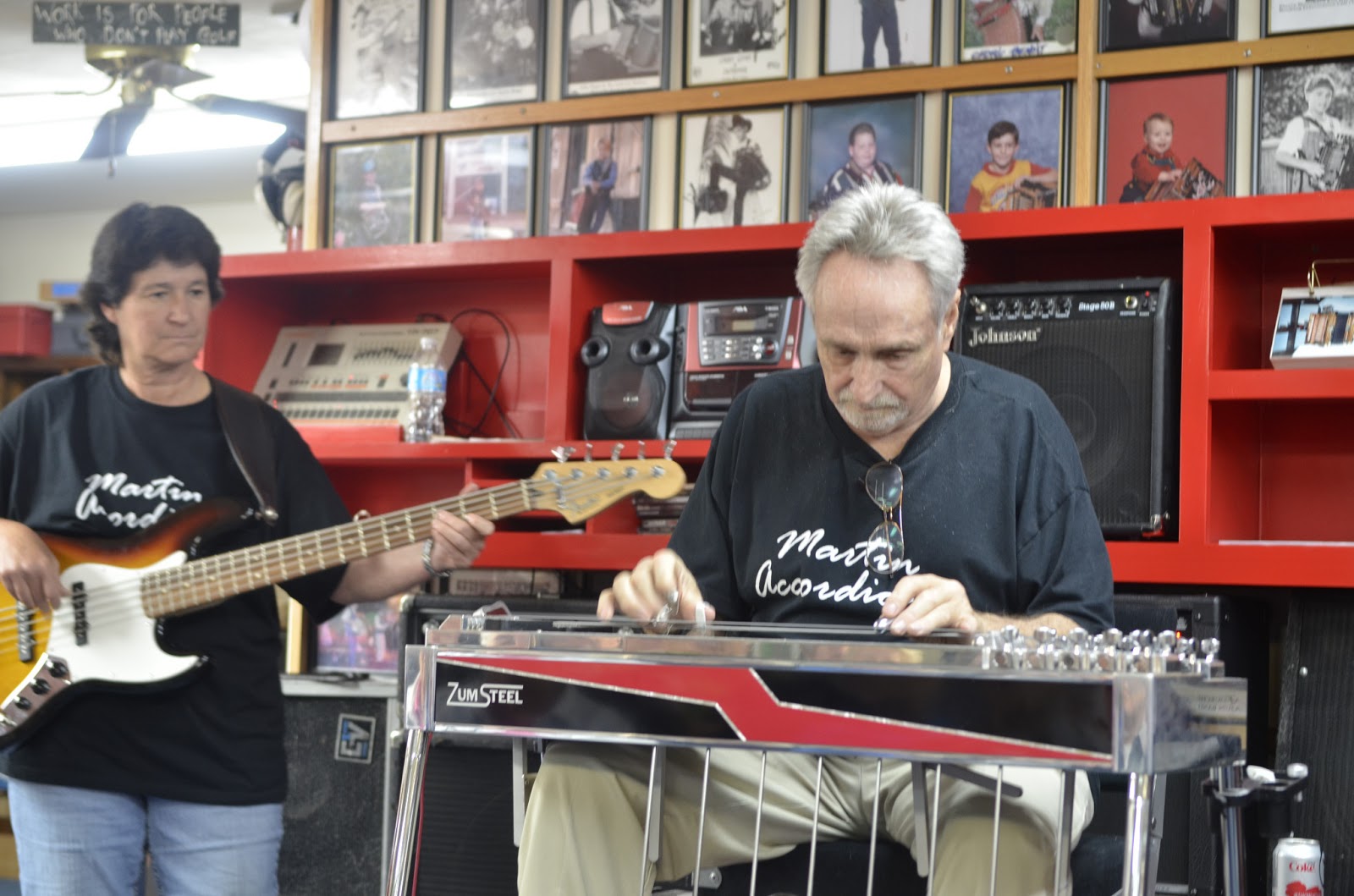
Rita arranged this lagniappe for our group and it was a unique treat.  Since 1985, the Martin family has made Cajun accordions.  We met Junior, the grandfather, Patsy, the daughter and a school principal, and Joel, grandson and musician.

They explained the differences between a piano accordion, made in Italy and using a special cardboard, a six-sided concertina, and the Melodian which is Cajun and the state instrument of LA.  The reeds and bellows are made in Italy, the rest is made by the Martin company in Scott, LA.  Their accordion is diatonic, using a push/pull method of producing tones.  They use both curly and birdseye maple.

The bellows are hand painted with their copyrighted logo, a crawfish.
Most are made to order and start at about $2600.  They can be had with gold keys for much more.  These shelves are filled with accordions in various stages of completion.
Cajun music has altered many times since the Acadians came to Canada.  Hank Williams, a non-Cajun, was influential in adding country flavor to the sound.  The Martin trio, accordion, steel guitar, and string guitar played the Cajun version of his hits Your Cheatin’ Heart and Hey Good Lookin’.

They explained that Cajun music is created by white Acadians who speak French.  Their percussion instrument is a triangle.  Cajun music is not written down; instead, it varies and tells a tale each time it is played.  Zydeco is Black Creole music that is soulful and sung in phrases. The words are half French and half English.  They use a scrub board for percussion.

The trio went on to play more for us including Amazing Grace, sung in French, and a love song written by Joel when he was first performing.  Joel and his grandfather have a special way of looking at each other to detect changes Joel makes as he plays.

Jerry took special interest in the wood shop and got some tips from one of the accordion makers (not how to make one though).

Our next tour was gastronomic.  Before imbibing on a seafood feast, we toured Crawfish Town, once a barn now a restaurant. 

Rusty, the head chef, took us back to check out the various stations where our dinner would be prepared.  We saw the crawfish crawl up a conveyor belt to be sized, packed in 35 pound bags, poured into steam-boiled seasoned water, covered with seasonings or breadcrumbs, and plattered for consumption. 


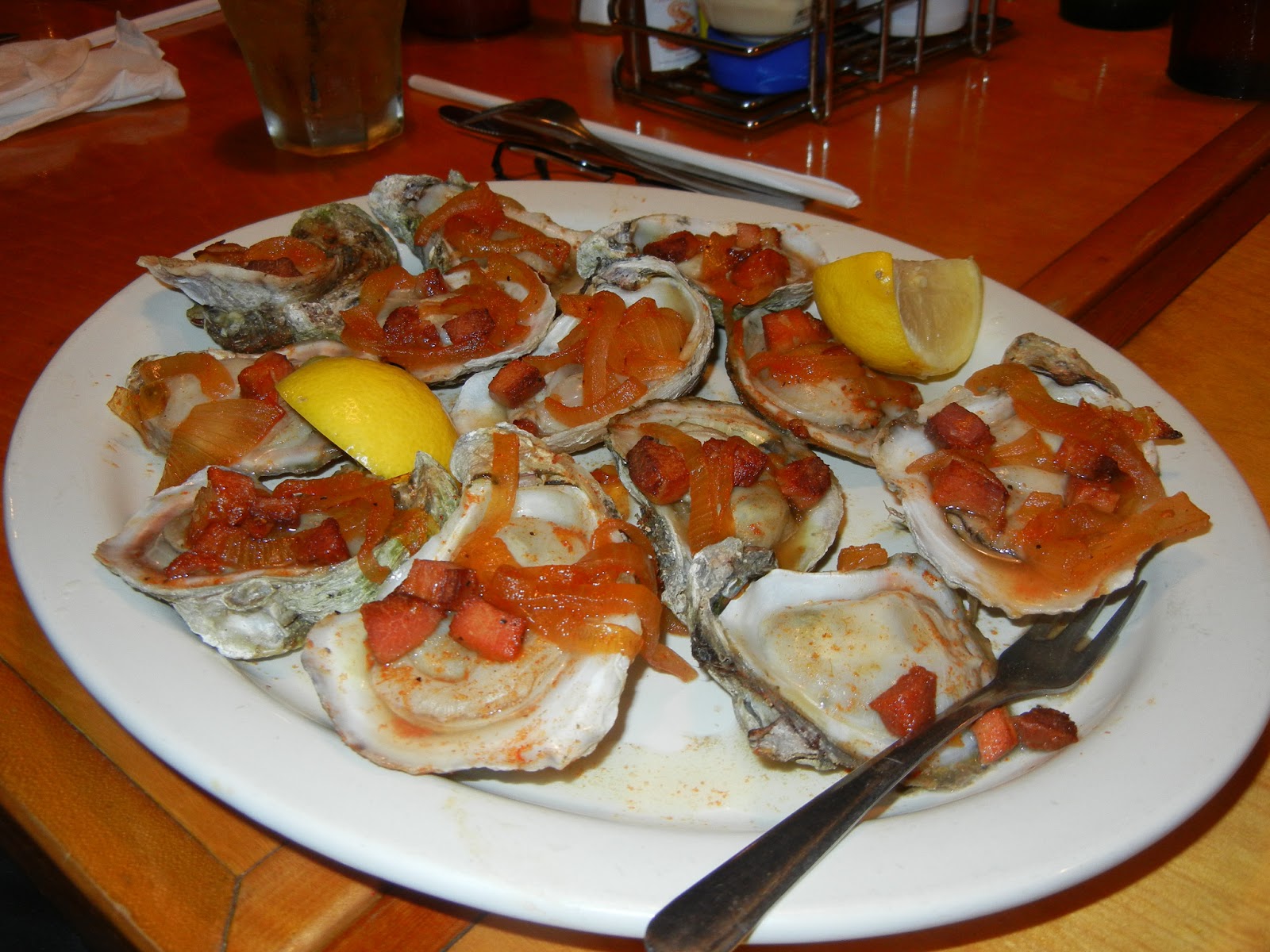
Our group consumed pounds of crawfish, shrimp, oysters and a few frogs legs.  We waddled out with smiles on our faces.
 

Tuesday, 23 April 2013

Hot & Spicy

Avery Island is home to the internationally acclaimed hot sauce known as Tabasco.  On the island is a plug of salt that is as deep as Mt. Everest is high.  The island was owned by the Avery in-laws of McIlhenny, a banker with a taste for hot spices.  He and his family have planted the cayenne peppers that are the main ingredient in the ubiquitous sauce. 
Our tour guide told us the peppers are now grown in Central and South America.  When the peppers match the color on the petite baton rouge (small red stick), they are ready for the first step in becoming hot sauce.  They are ground, salted and barreled the day they are picked.  Then they stay in Jack Daniel’s barrels for three years becoming a mash.  The barrels are topped with a thick layer of salt to protect the contents from outside elements.  Then the mash is mixed with vinegar and sits for twenty-eight days until it is ready for bottling into the various products Tabasco produces.  The company produces 700,000 bottles per day in a four-day workweek.
A short film again explained the process and advertised their latest product, chipolte pepper.

After the tour we did sampling and shopping.  Among the popular items to sample were jalapeno and tabasco raspberry ice creams. 

In addition to bags of sauces, we bought our spicy lunches.
Edward Avery McIlhenny, a descendent of the founder, was, among his many interests, a birder.  He was especially fond of the egrets that used the island as part of their flyway.  He developed The Jungle Gardens along the flyway.  We were in the wrong season to enjoy the plants of the garden, but we saw alligators, turtles and a large nesting of egrets.


Our leaders planned a lagniappe for us.  We gathered near the Buddha temple to enjoy wine and story time.  Peter, in his best California/Cajun accent, read Petit Rouge, Cajun Red Ridinghood.

  
We were all relieved when the alligator was brought down by a mouthful of Tabasco sauce and Petit Rouge found her Gram’mer.

Monday, 22 April 2013

Oil and Water

Today was a day that divided our group.  We each went to the same place but at separate times.  This is the story of the group that went oil rigging first, climbing twenty-nine steep steps to get up to the rig.
Mr. Charlie Rig is a first generation oil rig now used by participants of the Diamond Offshore Roustabout Training Program.  Our guide first gave us a history of two men significant in the development of offshore oil drilling.  “Doc” LaBorde, a Navy man, and Charlie Murphy, a boat owner, got together in 1952 and explored a number of ideas ending in the construction of their first offshore rig.

As good businessmen, they found that renting equipment was better than owning it.  That goes for such diverse items as drill  bits to uniforms.

 They have continued over the years to use the latest in drilling techniques, now doing much of the work by a remote computer.  However, they still need manpower.

The Charlie Rig is the training center for their recruits.  It is a self-contained community that stands forty feet above the water.  It is where the men and women learn to work, live, eat, and enjoy recreation within the confines of the rig.  All room, board, laundry and other needs are provided.  Even food is provided for the trainees and workers.
 The training includes first aid, rescue, and safety awareness in addition to learning the skills needed for their twelve-hour work shifts.

We saw models of rigs that have their quarters as much as 80 feet above the water.  These rigs have 140-180 workers; new ones will have as many as 360 workers.
This Oceaneering machine is use in under water exploration.

The derrick can lift 1,000,000 pounds while it pumps mud down the hole to cool the drill bit.
After the well is drilled by rigs like Mr. Charlie, this production platform attaches to the wellhead to pump out the oil and deliver it to a tanker or pipeline.

After our lesson in oil production, we headed off for lunch.  The restaurant suggested by our leaders, who have not been wrong in food choices yet, was overcrowded and we had to fend for ourselves.  The Cuban Restaurant we found was very good and a treat for those of us who have never had Cuban food.  The Cuban hamburger with its special sauce was a big hit.  Wilt bought an order of plantains for the table and enjoyed one himself.
Then we went to the water.  Cajun Jack was waiting for us to board his swamp boat. 
 He and his partner Dawn Jones took us along the Bayou Teche, through the locks and onto the Atchafalaya River.  Cajun Jack is a man of many words, most of them in jest and unrepeatable. 

What we saw is indescribable and needs our photographs to give a hint to the beauty of our ride.

On one side of the Bayou the homes are large and lovely.  On the other side, they are what Jack described as homes with a good view.

Jack told us about the flooding that has occurred in the river and bayou.  We saw the water line on the cypress trees.  We also saw the root system that grows down into the water and then curves to return above the water line.
A couple of Cajun boats loaded with crawfish passed us.  Only 52 Cajuns live in Bayou Teche now.
Bald eagles, egrets and blue herons flew overhead.  Turtles basked on logs, jumping into the water upon our approach.  Alligators drifted below the waterline, except for two who seemed too engaged in other interests to be bothered by us.

When we returned to the campground, we learned of a new member of our group.  Art and Rita are soon to be the proud owners of a new dog.

Sunday, 21 April 2013

Rip Van Winkle Gardens

 In the late 19th century, Joseph Jefferson spent his career performing Rip Van Winkle and a successful career it was.  He purchased an island in Acadian Louisiana and built a winter home in the Great American Style. 
 We spent a lovely, warm day enjoying his island.

We started with an excellent lunch on the patio of the Jefferson CafĂ©. 
 Most of us dined on caesar salad and a heavenly seafood heaven, a creamy basil sauce chockful of shrimp, crab, and crayfish atop angel hair pasta.  It was difficult to narrow the dessert choices down to just one.  We were so pleasantly full that we happily settled into the rocking chairs on Jefferson’s porch. 
The weather was so pleasant we were reluctant to go inside, but it was worth leaving our comfort to see this beautiful home.  Jefferson sold the home to Jack Ballis in 1920.  Ballis and later his son made the house even more of a show case.  The Ballis family made their fortune first in whiskey and then in salt.  In 1950 the son arranged for the house to become a museum.  Again, photographs of the interior are not allowed.

Among the things we saw are excellent pieces of French furniture along with a painting of Marie Antoinette.  The library has a folding captain’s desk that has swinging cases for file storage.  Coins alleged to have been pirated by Jean Lafitte are in a case on the mantle.  President Grover Cleveland slept in the visitor’s room.  The dining room is set with Limoges china and has a steamboat gothic ceiling.

Near the house is a more modern structure, a 1950s bomb shelter

Ballis and his French gardener created acres of gardens.  Our walk took us to a tea house and by sculptures ranging from modern to Asian.


 The air was filled with the screech of peacocks in full display.  Raccoons pranced among the tree branches.
In 1980 this island suffered a startling event.  The lake in front of the house had a large salt dome which was an active salt mine.  Also on the lake were oil and gas drilling.  For still unknown reasons these two industries collided resulting in a gigantic sinkhole destroying sixty-five acres.  The miners, some down 1500 feet, were all evacuated within forty-five minutes of the event without any loss of life.  The legal dispute was the biggest lawsuit in Louisiana history.

Saturday, 20 April 2013

New Iberia

We had a quiet morning of relaxing and catching up before we began another tough day of enjoying LA.  Our first organized activity was eating.  We stood in line at the unremarkable looking Bon Creole Lunch Counter for their oversized po’ boy sandwiches and baskets of fried seafood.  Fingerlickin’ good.
Then it was on to the Conrad Rice Mill which dates back to 1912 and has continued to use much of the same equipment for those 100 years.  Holly told us the steps for growing and processing the rice.  The company has grown considerably in recent years, selling 1,000,000 pounds of rice annually. 
Twenty-three employees work in the mill at stations with a hulling machine, paddy machine, pearler, and bagging machine. 


We enjoyed samples of rice and their Bay Island Secret Sauce in the Konriko Company Store.  Almost everyone walked out with a bag heavy with rice and other souvenirs.
 Anna Lee and Rita did some heavy lifting.


Our drive through New Iberia took us by some lovely old Southern homes.  Our destination was Shadow on the Teche Plantation but first a few of us went geocaching at a Lourdes Grotto near the public library.
 Back at the plantation we viewed a movie about the Weeks family who built it in 1841 and owned the plantation for four generations.  The last survivor, Weeks Hall, died in 1958, the day after he donated it as a National Historic Site.  The family made their money from sugar cane and were one of the most successful in the state.

The exterior is in the classical revival style with a brick facade to demonstrate the wealth of the owners.  The interior is Louisiana colonial, having no internal hallway or stairway.  This means, one has to go outside to get into rooms next door or upstairs.
 Eight-five percent of the furnishings are original, the remaining are of the same period.  The doors and wood around the fireplaces are faux painted to look like better wood or marble.  The tables and chairs are lower than we have today because the people were shorter then.  The wall paper, rugs and drapery duplicate what was originally in the home.  In the attic, boxes filled with hundreds of receipts, notes and records provided vital information on the house and on the farm.

The last descendent, Weeks, was an artist.  His paintings hang in bedroom.  The door was autographed by such noted people as Henry Miller, Elia Kazan, Tex Ritter, and Mickey Mouse (done by Walt Disney).  We regret that no photographs are allowed in the house.


 All this work earned a reward, the LA treat of a snowball, ice covered in flavored syrup.  Other rewards were freezes and ice cream.