Sunday, 5 May 2013

The Breman

Corinne and Larry, new friends from the caravan, invited us to park our motor home in their driveway and enjoy another side of Atlanta.  The price for this offer was many hands of bridge which we all enjoyed even when the cards were bad.  They live in the Atlanta suburb of Buford where dining is surprisingly good.  Dinner at Sperata was delicious, and, for a change, not Cajun, and the service charming.

Between rubbers of bridge, Jerry and Anna Lee went to the Breman Jewish Heritage & Holocaust Museum.  The museum is in the Selig Center which houses the Atlanta Jewish Federation.  For a small museum, it does an excellent job of telling the history of the Jews of Atlanta.   This stained glass window is all that remains of any early synagogue.
Starting in 1862 with thirty families, the community has grown to more than 100,000 today.  In the 1850s Judah P. Benjamin was twice  nominated for a seat on the U. S. Supreme Court but declined in order to serve as Secretary of War and State for the Confederacy. 
Anna Lee was in Atlanta in the 1980s for an ORT (Organization for Rehabilitation and Training) Convention.  This certificate is from an ORT student in 1947 in Munich.
World War II brought many Jews escaping the Nazis to the Atlanta area.  The museum has personal accounts as well as family photographs and momentoes that the immigrants were able to salvage. 

Several student groups were touring the museum while we were there.  One docent, whose family was killed in a camp, questioned the students on what they would do if their neighbors were so threatened.  He then told the stories of the righteous who resisted the Nazis to try and save Jews from being sent to the extermination camps.  This Torah was rescued from a destroyed synagogue but is too damaged to use for ritual reading.
Further displays tell of the growth of the community and of  two major acts that affected it.  The first was the trial, questionable conviction, hanging and pardon of Leo Franks for the murder of a young girl.  This event led to the modern rise of the KKK.  The second event was the bombing of a synagogue whose Rabbi was active in the civil rights movement.  This brought out community support for the congregation and for those working for desegregation.
    
On a lighter note, we delighted in Chosen Food, a traveling exhibit that tells the significant role food plays in Jewish culture.  A model grocery has shelves filled with products that are kosher.

Another display explains that Coca Cola, a major Atlanta product, adjusted the ingredient glycerine so that the product is kosher.  Videos showing cooking demonstrations, table settings for holiday meals, and audio about lively conversations during family meals could have been taken from our own lives

After seeing all that Jewish food, we were hungry for deli and went to Goldberg’s for lunch.


. 

Wednesday, 1 May 2013

Georgia Aquarium

We spent the better part of the day at the aquarium and it was the best part of the day.  This ranks as one of the most outstanding aquaria we have visited and is considered one of the top three in the world.  The founder of Home Depot, Bernie Marcus, was the person instrumental in creating this outstanding marine museum.  He had donation help from major corporations like AT&T.  Within the seven sections are exhibits that elicit exclamations from visitors.  The areas explain habitats including Georgia waterways
the world’s rivers
and oceans.


While we found the Coldwater Quest with its penguins delightful,
we were less impressed with the “Disney-like” show of Dolphin Tales and most impressed with the Ocean Voyager that has a glass tunnel over which whale sharks, sting rays and many fish swim.  This exhibit is so good we went back through it three times. 

Upstairs we saw a large exhibit on frogs.  These quotes were thought provoking.


While school groups, families, and foreign visitors were everywhere, we did not feel crowded or hurried during our four-hour visit.

Our next stop was unrelated to animal life.  We went to the Paper Museum on the campus of Georgia Tech.  The museum tells the history of paper from its early Chinese, Indians and Arabic origins through its development in pre-Renaissance Europe to the industry that it is today.  Some of the quotes were interesting. 


Southern History

Our caravan has ended and we are continuing through the South on our own.  On our way along a scenic byway in Alabama, we saw signs for the Tuskegee Institute.  We learned that it is undergoing renovation but that the Tuskegee Airmen National Historic Site at Moton Field is open.  We wandered through Hanger 1 reading displays and listening to recorded personal accounts of the history of this one and only black Army Air Corps training facility.    Piper Cub and a Stearman used in training were on display.  Both are still in flying condition.

A friendly ranger let us have a sneak peak at Hanger 2 which will open later this year expanding this story important story and including more information on the social obstacles and impact their training had on integrating the military and ultimately on desegregation.  The primary exhibit is this Red Tail P51.       
We then continued on to a beautiful campground in Atlanta.  The next morning we went to the Atlanta Cyclorama (the only other remaining Cyclorama is at Gettysburg).  We learned about the train battle between the Texas and the General.  Union soldiers hijacked the General aiming to destroy supply and communication lines.  They were ultimately stopped by the Texas, the Confederated locomotive.
 Some of the Union soldiers were hung, some imprisoned and some escaped.  All but one, a civilian, were the first to receive the Congressional Medal of Honor.

The tour started with a brief movie on the Atlanta Campaign led by Union General W. T. Sherman.  Then we went upstairs where we turned a slow 360 to watch the painting on a linen screen the length of a football field.  As each scene of the battle moved in front of us, a narrator explained who was shown and what was happening.  We saw the efforts of the Confederacy in their losing battle to defend Atlanta from Sherman’s army.  Painted on the screen and created as a diorama are the fighting, the wounded, the dying.

Our informed and amusing guide, “Abe Jr.,” gave background about the Cyclorama.  This remarkable production was commissioned by Union General John Logan as “Logan’s Great Battle” for his campaign for vice-presidency after the war.  It was created by a German artist from Wisconsin and his staff.  Logan died days before its completion and the Cyclorama went on tour with the circus.  Eventually it was acquired by the City of Atlanta and given a permanent home.  We learned such tidbits as that the five men who helped in making the figures in the diorama put their own faces on all 130 soldiers.  Also, after Clark Gable saw the Cyclorama, he suggested it would be better if his face were used and so it was, on a dead soldier.  No photos are allowed of the show but Abe did allow his picture to be taken with Anna Lee.
Next we drove to the Oakland Cemetery.  There we visited the Confederate, Jewish and African-American sections. 
 The obelisk is a monument 3900 Confederate soldiers.
and the lion to 3000 unknown soldiers.
Margaret Mitchell Marsh is buried here

as is Martha Lumpkin Compton for whom Marthasville was named.  In 1845 the town’s name was changed to Atlanta.  Several prominent African-American leaders of Atlanta are also buried in the cemetery, but no longer in a segregated section.
We visited the MLK Memorial but were too late to see the exhibits in the Center.

We are staying in a most lovely campground, Stone Mountain, located in the suburbs of Atlanta.  Our neighbors are a turtle and a mother duck with her brood.  Out our front window is the lake.  It is wonderful to be in such a gorgeous setting yet so close to the things we like to do.
The famous feature of Stone Mountain is the Gustav Borlund carving of Robert E. Lee, Jefferson Davis and Stonewall Jackson.


Monday, 29 April 2013

End of the Caravan

Our leaders took an oath at the beginning of the caravan that we would all gain twenty-five pounds.  They have worked very hard to honor that oath including having croissants for our last meal together.  They even went so far as to place a bathroom scale on the ground at our parting breakfast so that we could see if we “measured up”.

Some did and some didn’t.

We have all managed to get around that oath a bit by filling our refrigerators with white take-out boxes that will be breakfast, lunch and/or dinner for days to come.
As we wrote nineteen days ago, we gathered as friends and strangers from throughout the country.  We leave as good friends who have shared a unique adventure that could only have been put on by our great leaders, Rita, Art, Betty and Jack.  Their knowledge and love of Acadia has rubbed off on us and we will all treasure the memories.  Rita introduced us to her personal friends and their special talents and provided us with rare experiences.  She has threatened each of us with becoming her “ami”.

We will smile at memories of U-turns, cheery smiles, Southern drawls, friendly politics,      
skilled repairs, travel tips, clever quips, thoughtful acts, good conversations and way more food than we thought we could consume.

 The nice thing about traveling in motorhomes is that we know we can meet along the road in the future and reminisce about LA Lagniappe 2013.

Sunday, 28 April 2013

A Very Busy Last Day

It takes a lot to get this group up early.  Our leaders cajoled about half of us to rise before six am to get in line for breakfast.  This was not just any breakfast, but a zydeco breakfast.  We stood or sat outside for over an hour taking amongst ourselves and with visitors and locals all in line for the seven-thirty opening of CafĂ© des Amis.
 
Their pancakes and omelettes are worth a wait.  The zydeco band that played as we ate was the major attraction.  The small dance floor filled as the band played this creole beat.  Locals come every Saturday morning to dance; visitors from all over the world join them and everyone has a good time.


 Peter even tried out for the band.
This restaurant is responsible for the success of the small town of Breaux Bridge.  After it opened and got attention from the Food and Travel Channels, antique shops, inns, and other restaurants opened to meet the needs of the increasing number of tourists.

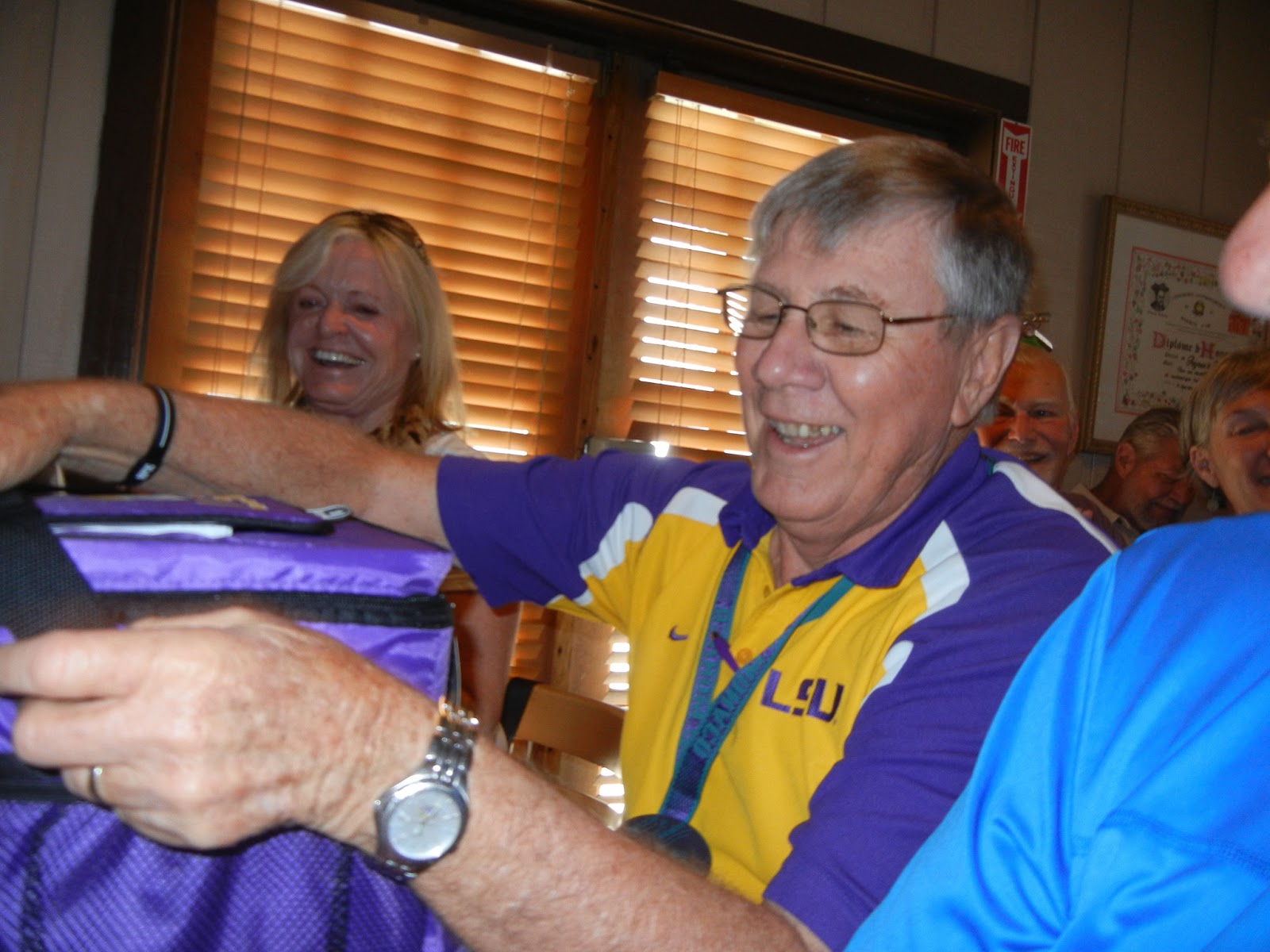
Believe it or not, our next activity was a Cajun lunch at Prejeans.  We took this time to celebrate and thank our caravan leaders with appropriate gifts: for Rita, a book on New Orleans houses; for Art a collar for the new dog, for Betty and Jack, LSU fan paraphernalia.


Then we took a tour of St. Charles College in Grand Couteau.  Originally a plantation, it was donated to the church by the Smith Family.  It became a girls’ school, then a Jesuit boys’ school.  In 1907 the wooden buildings burned.  In 1925 it was rebuilt as a seminary for Jesuit boys.  Since 1970 it has been a seminary,  a retreat where parishioners come to contemplate in silence under the guidance of a priest, and a retirement home for aging priests. 

Brother Huck took us on a tour of the building that will be reopened from its latest renovation on Monday, April 29.  He explained the changes made in the building and how updates were incorporated.
The cemetery dates back to the 1800s.  General William Tecumseh Sherman’s son, a Jesuit Priest, lies next to the son of the vice-president of the Confederacy. 

This old classroom brought back memories for many of us.

We left the church and took a brief tour of the Acadian History of the Prairie Museum.  The time line detailed North American history from the arrivals of the Acadians to Canada in 1604 to their coming to New Orleans in 1785.

We ended the evening at Liberty Theater in Eunice with a presentation at radio station KRVS (note the call letters).  Every Saturday evening the station presents a ninety-minute program entitled the Cajun French Music Show.   The quintet of a guitar, bass, fiddle, drum and accordion played two-step and waltz music that members of the audience danced to.  A father and eleven-year-old son also played a couple of tunes.  It was nice to see this young boy continuing his heritage.

Saturday, 27 April 2013

Cajun Immersion

Vermillion Ville is a Cajun/Creole Heritage and Folklife Center and one of the best living history museums your blog writers have visited.  The Center deals with the years 1865 - 1890.  Most of the buildings brought here are authentic.  Their furnishings are also authentic.  Many of the buildings have a craftsman to show visitors his/her art.

Before starting the tour, we enjoyed gumbo, tilapia, crawfish etouffee on pasta, glazed carrots, broccoli biscuit, and, of course, bread pudding.

After lunch our escort docent took us on a tour of the Center starting with the 1840 Arcenious house.  Mr. Arcenious was one of the people who introduced cotton production to Acadia.  In his time cotton was the leading component of the country’s gross national product.  The government bought most of the cotton and then sold it on the international market.

The cotton spinner demonstrated her spinning wheel and told us it takes her a year to spin and weave the cotton to make a shirt.  She could tell the strength of her thread by sound and touch.   It takes fifty hours to gather a bale of cotton and six bales to make the material for a shirt.  That shirt could last decades.  Brown cotton is for personal use and white is sold.

These rolls of cotton have been died from natural products on the farm.

The loom is more than 200 years old and is no longer in use.
Quilts served a purpose beyond warmth on the bed .  They were communication devices.  When a quilt was hanging on the porch, it was an invitation for people traveling on the river to come in.  It could mean help was needed or company desired. 

Chimneys were painted white to indicate the daughter was available for marriage.

In the Ecole, school, Mr. Merlin fiddled tunes.  He is eighty-nine years old, fought in WWII, and has a reputation as a flirt.  He played G-d Bless America, Dixie and Yankee Doodle. 
This message on the chalk board warned students not to speak French anywhere near the school.
Below the chalk board are the French and Creole flags.

Students would bring vegetables in these cups to put in a common pot to make jambalaya to share for lunch
Maison Mouton is a replica of a house built in 1810. Cliff, a woodworker, explained the hand tools on display.  The first ones were provided by the Spanish government (Spain owned the land when the Acadians first came). 
He explained that a fungus in wood creates this spalted effect.
These passe partout saws were passed from neighbor to neighbor.

An outside room of the house was for visitors to stay in.  Since they were generally strangers, they did not have access to the rest of the house.

A seventh-generation blacksmith was in La Forge.  He explained that the three essential tools were the anvil, hammer and fire.   
La Maison Acadienne is a hospital, emergency room and pharmacy.  The garden club has created a Healer’s Garden filled with medicinal herbs labeled as to the conditions they treat.
 Considering that some Acadians lived in Haiti before moving to Louisiana, the hospital also had voodoo dolls. 

Maison Boucvalt belonged to a German family and had an indoor toilet.  Th picture was made from hair of a girl who was either deceased or had became a nun.

 The barn had a 500-pound bale of cotton (standard size) and wooden tools.
A Creole dollmaker demonstrated her clothespin dolls that take four hours to make.  A corn shuck doll takes a year to make.

We took a ferry across the stream to the church.  It is a replica of a non-denominational church.  The pelican is a treasured symbol because it will sacrifice its own flesh to feed its young.
The rectory was built in 1830 and has its interior door atilt.

Our final artisan was a builder who used the traditional boussage, (moss, mud and horse hair) to line the walls of homes.  Spanish moss, named for its similarity to the beards of Spaniards, is used for rope, mattress stuffing, and some car seats.

The last buildings on our tour were a washhouse, a kitchen and a native Palmetto cabin.

The tour reinforced and increased what we have learned in our travels through Acadia.

In the evening we continued our “lesson” in Cajun food at Randol’s.  This dinner had a wonderful Lagniappe, Cajun dance music.  While some of our group graced the dance floor, others got great pleasure from watching.
 Mr. Merlin from Vermillion is a fiddler in the Cajun band at Randol’s.
Our leaders Art and Rita tripped the light fantastic.
 Pam is a happy dance partner.
Carolyn is adept at Cajun dance.
 Peter and Carol looked lovely on the dance floor.