Friday, 13 May 2016

The Brandywine River Museum of Art

 We came to this area for more than chocolate, we also wanted to revisit the Wyeth family museum that we had visited briefly a few years ago.  This time we wandered the museum and took tours of N.C.’s and Andrew’s homes and studios and visited the Koerner Farm.

This family dynasty started with N.C. Wyeth who was trained in painting by his father. 
He went on to become a famous illustrator doing book illustrations for Robert Lewis Stevenson’s “Treasure Island.”

This first work was so successful he was able to buy property and build a family home in the Brandywine Valley.

He illustrated William “Buffalo Bill” Cody’s “The West That Was”


Jules Verne’s “Mysterious Island”

James Fenimore Cooper’s “Last of the Mohicans”
and 1300 other illustrations and 300 paintings.  Wyeth was fascinated with the West and traveled there, even delivering mail via horseback, to learn and see this developing area.

N. C. and his wife Carolyn raised five children, two boys and three girls, expecting them to help maintain the house as well as learn art.  Three of the children became artists, one a musician and one a mechanical engineer (developing the plastic soda bottle).

The livingroom contains the piano played by Ann Wyeth McCoy, a musician as well as artist.  N.C. would spend the evenings before a roaring fire reading classics to his children.
N.C.’s studio contains the Caproni sculptures he used as models.  Can anyone recognize who is on the bottom???
This mural of William Penn leading followers to the New World was previously on display at the Penn Mutual Life Building.
This is our guide talking about the last painting he was working on before he died in a tragic auto accident.
This Penobscot canoe appeared in many of his western paintings.
The prop room brims with his collection of items that he used to illustrate in his paintings.

On another floor of the museum are paintings by Andrew, N. C.’s most famous offspring.  N.C. bought a home near his own for one of his children.  Andrew and Betsy lived there with their sons Nickie and Jamie, a famous painter in his own right.  The home became Andrew’s studio where he would “hide” while working and listening to loud classical music.  A sign on the door tells visitors not to enter. 
He was fascinated by WWI and had a large collection of thousands of toy soldiers.

Andrew took up the use of tempera (pigment in egg whites) after learning the technique from his brother-in-law Peter Hurd, a successful New Mexico artist.  Andrew preferred buying his eggs at the local WaWa Market.
He was sickly.  Dr. Syn is a self-portrait based upon Xrays after coming home from hip replacement surgery.  
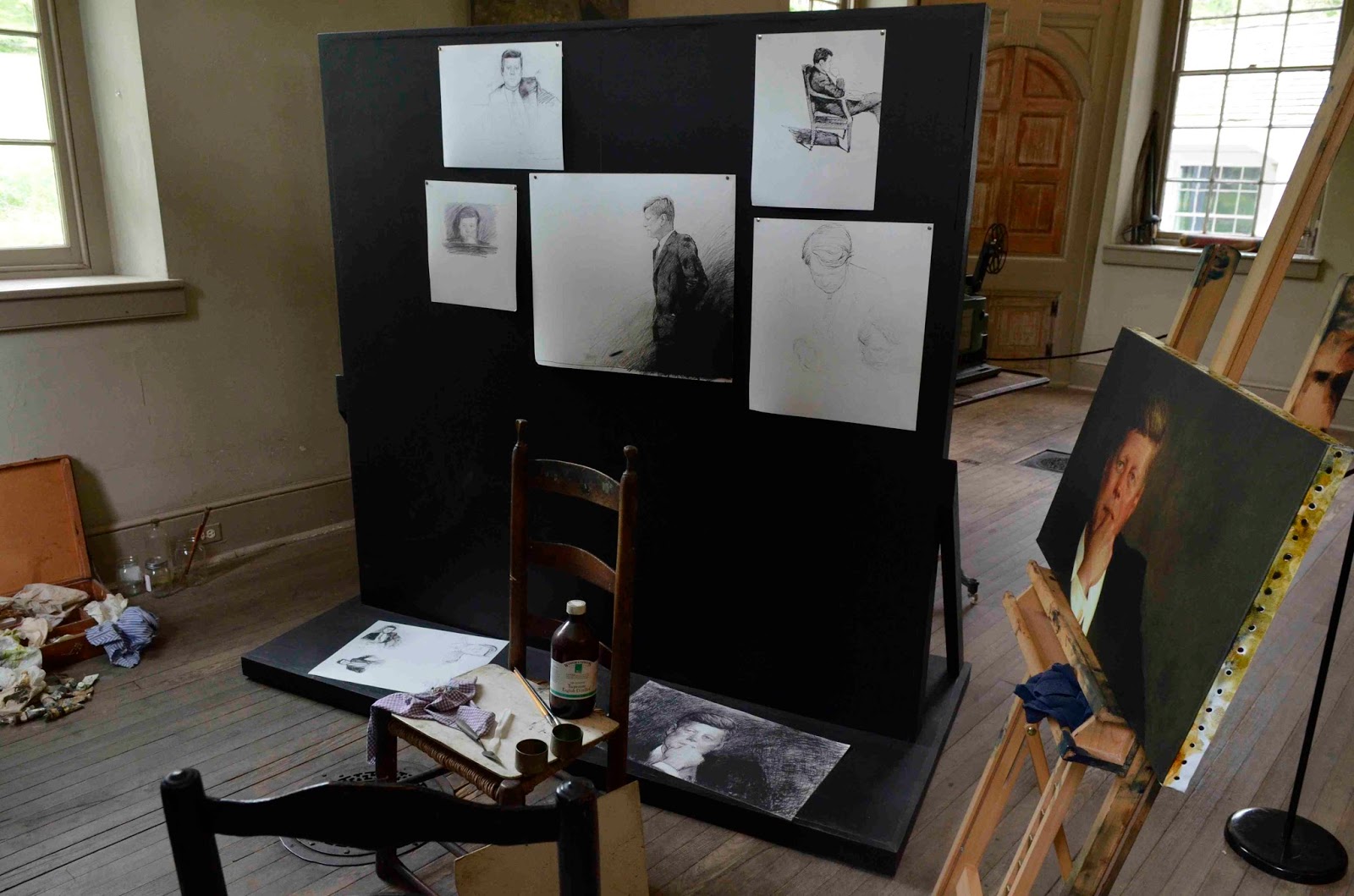
Andrew’s studio became his son Jamie’s who was trained by his aunt Carolyn.  He was friends with the Kennedy family.  His portrait of JFK was painted in 1967. 
Our third tour was to the Koerner Farm, destination of Andrew during his youth and adulthood.  Koerner and his wife left Germany after WWI and raised their family on a farm near the Wyeth’s.  This picture shows Koerner in a German uniform.

Andrew became like a son to Karl and spent many hours at the farm and even did some painting there. 

The barn burned down and this replacement is from a Sears Kit.
Back in the museum we looked at paintings by Jamie
his sister Henrietta
brother-in-law Peter Hurd
brother-in-law John McCoy
and sister Carolyn.
This is a view of the second floor of the museum
and this cardinal posed hoping for us to get a good picture.

We grabbed lunch at the cafe in the museum.  Sometimes you don't know what you're getting.  Anna Lee ordered mushroom poutine, thinking it was a salad.  The mushrooms, fries and cheese were amazingly good, so good she daren't order them again.  Anyone else ever enjoyed them?

While we saw almost everything, we could happily return again to this outstanding museum.


Wednesday, 11 May 2016

Lititz

The name of this town makes our mouths water.  For those of you who have savored the taste of Wilbur’s Chocolate, just the name makes your mouths water too.  We came for the chocolate, but we made ourselves earn it.  We took a 10K volkswalk, wandering the town of Lititz.  Sadly, most of the walk was dull, but when we got to the two hundred year old buildings in the downtown, we found ourselves walking slower and enjoying it more.  The town started as Moravian village in 1741 as a refuge from persecution by the Catholic Church in Europe.  Wounded soldiers of the American Revolution were housed in the Brethren House.

This home must belong to an antique collector.
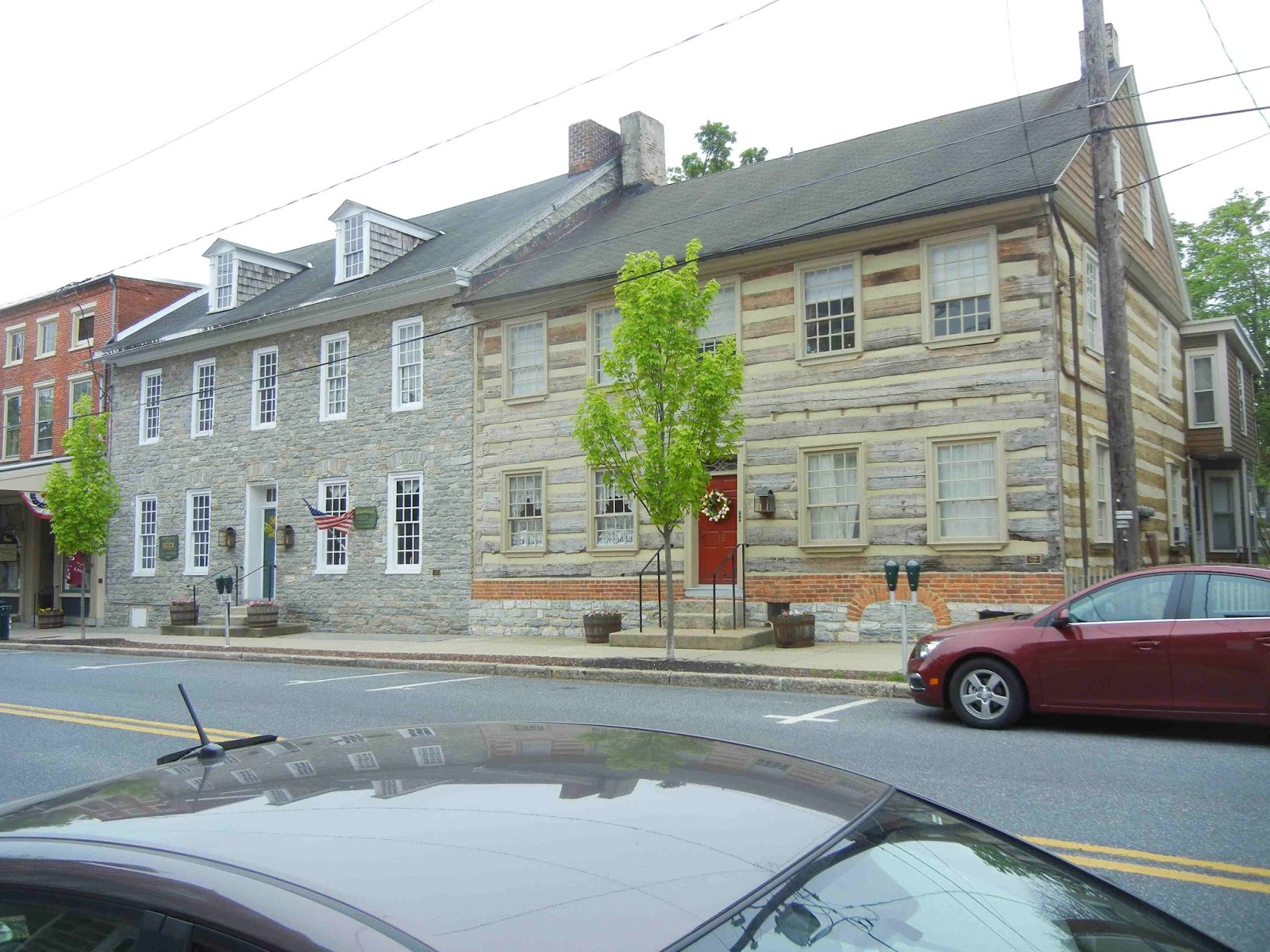
The style of these homes, just feet from the main street, harken back to an earlier time.

Lititz is known for more than one kind of delicacy.  The Julius Sturgis Pretzel Company also makes a tasty treat.
But chocolate is what we wanted and what we got.  We even had orders from family members to bring them their Wilbur’s.  Happily we complied.
The shop has shelves of chocolate in many forms.
This treat was brought in by a delivery man while we were there and it really had Jerry excited over the prospect of trying it out.  No samples of this however.
They also have a collection of china chocolate pots.
Watching the employees fill the molds made us return to the sample bin for more tastes.
John Sutter of gold rush fame is buried in a Moravian Cemetery in Lititz but our search did not locate him.  Swiss born, he moved to Lititz, home to many of his fellow countrymen.  Broke following the destruction of his land holdings by gold miners, he and his wife moved here when he was trying to get  reimbursement for his help in colonizing California.  As usual, Congress failed to act.  He died in Washington DC and was returned to Lititz for burial.

We didn't just satisfy our sweet tooth, we went into Intercourse to shop for chicken pies at Stoltzfus.  On the way back to the RV, we stopped at a farmer's stand for delicious asparagus and tempting pastries.

This lovely home was along our route to the campground.
This is Amish Country with buggies commuting along the road.  The hills can be so steep drivers have to pause at the top to be sure there isn't a buggy ahead.
farmers tilling their lands with teams of horses or mules,


 girls and boys pushing scooters up the hills
 and large farms with multi-generations living in the expanded houses.
Disavowing electricity, clothes are washed by hand and hung out all day to dry.
In addition to the Amish, the area has been settled by Mennonites, Moravians, Catholics and Protestants.  There are many, many churches.  There is also a Jewish community outside Lancaster, the major city of the area.  We read in the paper about a Jewish Food Festival occurring this weekend.

This is a lush, green land with hilly, narrow roads.  It is a pleasure to view and a lovely place to visit.


Kinetic Sculpture Race

When we bought our first motorhome, we enjoyed a long weekend on the northern California coast.  In Ferndale, near Eureka, we chased kinetic sculpture (bicycles made to traverse water).  It was great fun watching the costumed riders on their creative vehicles. 

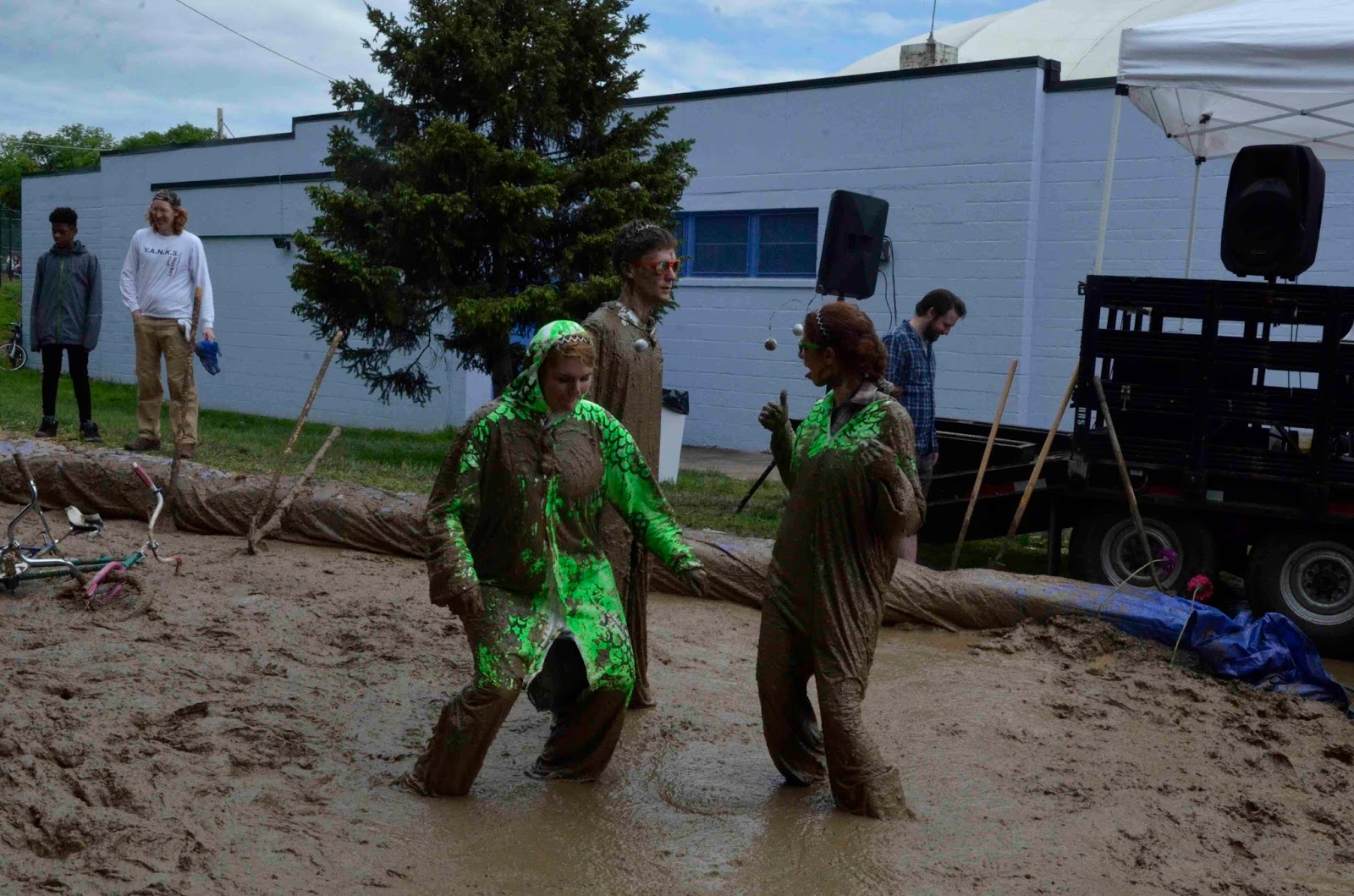
The city of Baltimore has decided to do an East Coast version and we headed out to see how much fun it was.   We joined friends of Cheryl and Dave for a delicious Mexican lunch.  After lunch we walked to the park and found a great spot to watch the “bikes” go through a muddy obstacle.  Some got through better than others who had to have a team to push.


The people keeping the mud flowing had a great time dancing.
After all the vehicles got through, the children splashed and bathed in the mud.

In the evening we had a pre-Mother’s Day celebration at good friends’ home and then indulged in yummy desserts.

Mother’s Day continued the next morning with a relaxed day at home followed by an intense play at Arena Stage.  We saw the drama “Disgraced” about a successful Moslem lawyer whose life and those of his wife and friends fall apart.  The after-play discussion was excellent, touching upon immigrant life in America, prejudice, understanding, and whether there is hope.