Thursday, 11 April 2019

Buenos Aries

We are concluding our trip with a few days in this fascinating city.  Our hotel is a couple of blocks from the Historic Cloisters.

Next to the cloisters is an amazing Central Cultural Recoleta. The rooms and halls are filled with murals.

American U-tube videos tell young people’s stories of being gay, wanting to be pretty and losing weight.  These are both fascinating and disturbing.

This tram is full of graffiti.


Rooms around the center are filled with a variety of chairs, some used for relaxing and others for working.
Small rooms have a few more exhibits.


This guide explained that all the exhibits are temporary, even her shirt.  Every few months everything changes.
Nearby is the famous Cementario de Recoleta.  These mausoleums are the final resting place for the rich who want others to know they are rich.


Walking along the paths between the mausoleums is like being in an overcrowded city of tiny homes.  Each is owned by a family who pay taxes on it and are responsible for maintenance.  When no longer supported, the site returns the city.
 Evita Peron is the most famous person buried here. People still leave flowers.
In this crypt rests a young woman who, legend has it, was in a catatonic state and may have been buried alive.
 Though all of stone, the architectural designs vary. 

Recoleta continues to be a burial site.  A large group of mourners gathered outside the cemetery for a new burial.

Near the Recoleto are many small restaurants.  The service is so different from the US.  You seat yourself and, eventually, a waiter brings a menu.  A bit of time passes and you give your order.  Then you wait.  You can linger over your meal as long as you like.  Most of the other customers are actually talking with their companions, not looking at their cell phones.  You get your bill when you request it.  Such a calm, relaxing way to dine.

Nearby is also Freddo, one of the top rated ice cream parlors,
We confirm that rating but may need to test the competition.     

Wednesday, 10 April 2019

More Iguazu

Brazil is just a few miles from our hotel, that is as the birds that fill the air fly.  Our drive took us about an hour, including leaving the National Park, driving to the border and then entering the Brazilian side.  The Brazilian side is more touristy with lots of hotels and stores.  From our hotel we can see this old hotel. 
 We met guests who were staying at ours who said this one was much more elegant, but we like that the Malia is just steps from the walks to the falls.  Now back to our next view of the falls.

The bridge we took to cross the border between the countries has green and yellow barriers on the Brazilian side and light blue and white on the Argentinian. 

Brazil has the side that faces all the falls. The park is 20% in Brazil, about 80% in Argentina and a tad in Uruguay.  Both of the two major countries claim the best views; we agree they both have the best views, just of different angles.  Brazil gives a panorama from above and below; Argentina offers individual views from below and beside the falls.

The name Iguazu, in the indigenous language, means big water.  What an understatement.  The view above the falls is unbelievable, water cascading to the left, center and right.  The roar of water crosses the chasm.


From above we could see people on the Argentinian trails.

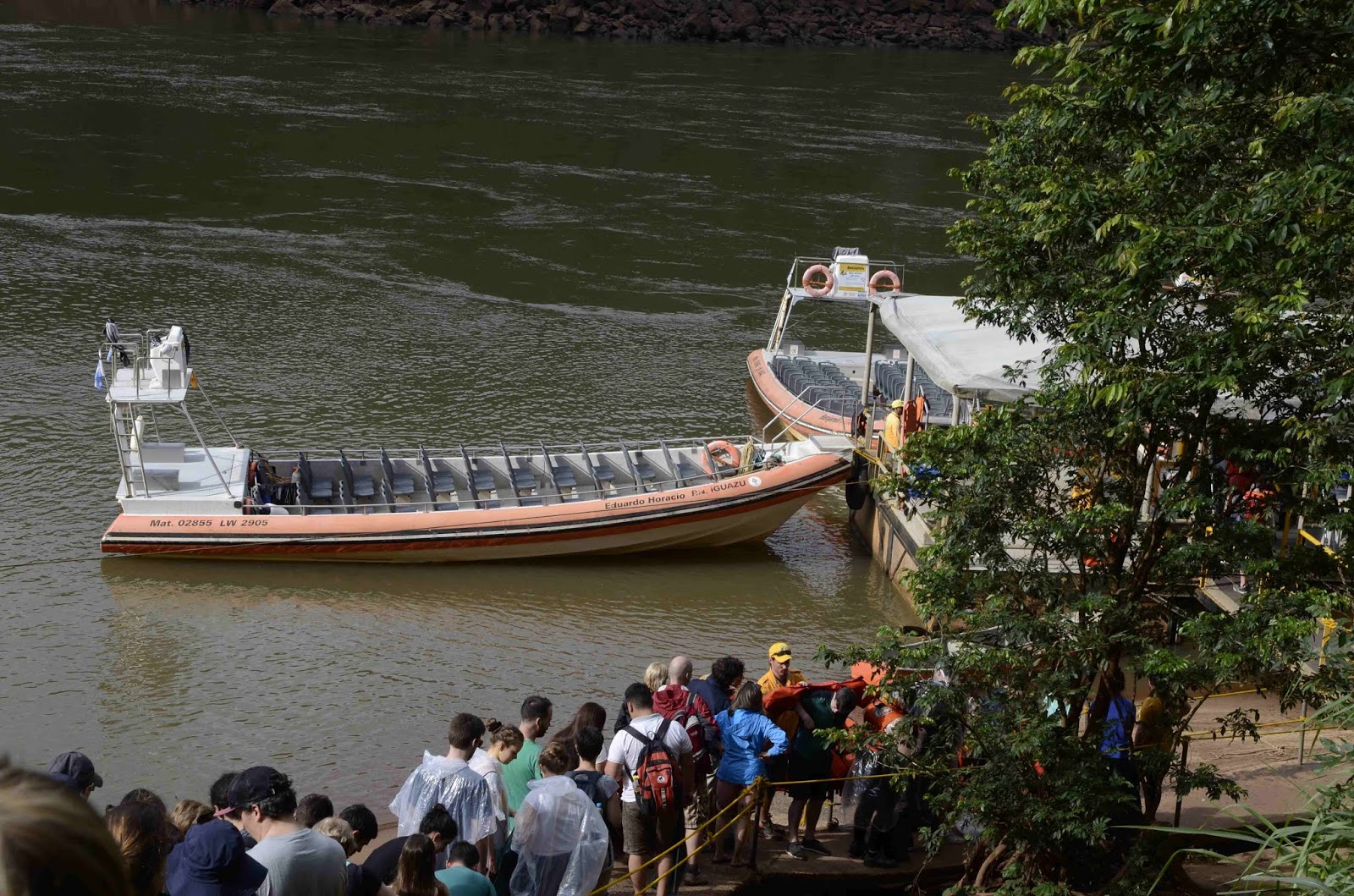
and we had a view of the boat we took the day before.

This formation looked like a monster climbing up from the river.

As we wandered the path this butterfly lit upon our guide’s hand.
 Upon our return to our hotel we took the fourth trail to see more falls up close.


More butterflies appeared, one landing on each of our hands.  Their feet have a very light prickly touch.
The morning we left, we took time to watch the distant falls enjoying this amazing landscape.

Monday, 8 April 2019

Iguazu Falls, Argentina

So many friends have told us how beautiful these falls are.  Well they were wrong, they are even more spectacular than we expected.  Our private guide for two of the trails informed us that the water streams along reaching the deep volcanic cataract where it tumbles down at rate of million meters per second.  There are 70 species of fish, 50 mammals and 800 butterflies.

We have hiked all four of the trails.  We started on our own with the Green Falls.

We encountered the resident coati who have trained humans to drop food for them, not a good idea.
The next day we had a private guide giving us information as we hiked two other trails.  First we took an unusual train up to the Devil’s Throat, a fantastic group of waterfalls.


The guide identified for us

Uracus bird
and purple morning glory.

At the Two Sister Falls we also saw this Golden Spider which weaves the largest web of all spiders.

In the afternoon we rode a boat through the falls.  Anna Lee did not enjoy being pelted by hard drops of water and being soaked, so Jerry will describe this experience.  

Anna Lee does not appreciate a true thrill ride.  We descended 250 steps from the road to the river where we were given rubber bags for our valuables including cameras and anything else we did not want to get soaked.  Then we put a life vest and got on to the boat with about 100 of our closest friends. 

This is a photo that I Jerry took from above of another boat approaching the falls.  You can see where our ride went.
We then rode to the San Martin waterfall. 


The skipper stopped to allow us to take pictures then we were told to put our cameras into the bags and we proceeded to take several showers courtesy of the second largest waterfall in the park.  It was great but, two days later, our clothes still have not dried.  Well worth the experience.  The problem was that, soaking wet, we had to climb the same 250 steps to get to the van to take us back to our hotel.

We recovered with a wonderful dinner at our hotel.  Rooms look out to the waterfalls or into the jungle.  We are on the jungle side.


These are more photos of the various falls


Friday, 5 April 2019

Montevideo, Uruaguay

Yesterday rain, now a cold wind blows.  Montevideo is a poor country lacking natural resources.  Tourism is a main industry, as is the exporting of meat.  The streets seem to tilt with the many apartments stacked atop and next to each other, many of these stand vacant..

Our last stop on the cruise was a history lesson about the Jews of this area.  Of the 3,400,000 population, about 10,000 are Jewish.  Starting with the Spanish Inquisition, continuing through the Sultanate of the late 1800s and Tzarist Russia, and culminating with the Holocaust, Jews have migrated to South America.  The community here is close, but shrinking with many of the families migrating to Israel.  This population is down from 40,000 after WWII.

Our first stop on the tour was at the Holocaust Memorial with its respectful array of stone monuments.

Monuments include an inclining wall, a stark chimney, railroad tracks, and quotations from renowned writers.

Uruguay’s politics have wavered as far as Jews are concerned.  A dictator said the children could not go to school.  The current president, non-religious, says school is required for all and must be free, though there are several Jewish schools which are fee based (children who cannot afford them are on scholarship).

We visited two synagogues.  The first has a small orthodox congregation with a Moroccan torah. 


The men and women sit separately.  Weddings are performed at another venue.  Sadly, the building is deteriorating.

Next, we went to Yavne, a synagogue and school.  We arrived at recess and the outside filled with children of all ages, some boys wore kippot and tallisim and others bareheaded.


 According to the rebitzen who spoke to us, “The congregation is orthodox, but not so orthodox.”  They welcome Jews of any level of observance.  Women sit separately, but with a moveable glass wall so they can participate.  Halacha, such as wearing, kippot are not mandatory.  She described it as “a place to go when you want to observe.”   There is a strong sense of community including our guide whose grandchildren attend there.   

For those of you who remember ORT, there is an ORT school and our guide taught business English there.

Phase four of our trip is ending.  We have enjoyed the cruise, both places we have seen and people we have met.  Now on to further adventures.